
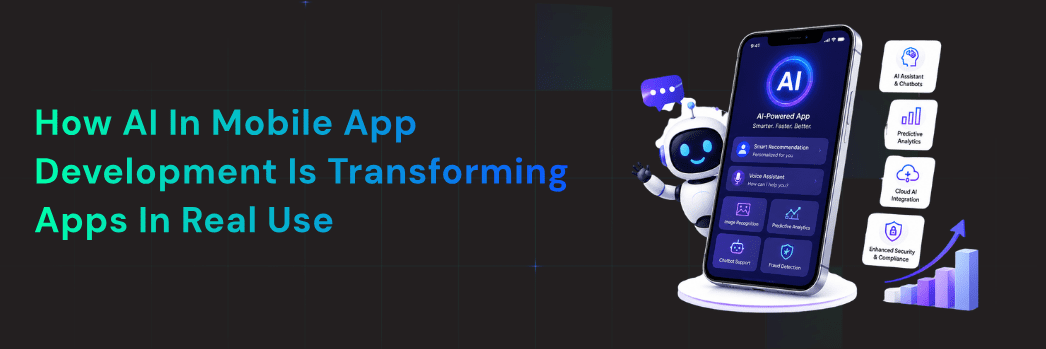
How AI in Mobile App Development Is Transforming Apps in Real Use
- Miss. Lily
- 2 min read
Working with the Right Team
Introduction
Artificial Intelligence (AI) has come a long way from being a buzzword in the realm of big tech companies and is now more accessible than ever. It’s turned into a commonly efficacious and strong instrument that’s transforming mobile application design and development and user experience. AI’s role in enhancing mobile app design is becoming increasingly evident in today’s digital age, transforming the way businesses create their applications. In the digital era, AI’s impact on mobile app design is undeniable, reshaping how companies build their apps to be smarter, faster, and more personalized.
AI is enabling businesses to develop apps that learn and adapt to user actions, offering suggestions, voice commands, forecasting, and automated support that enhance user experiences. With continuously growing expectations, businesses are desperately looking for innovative mobile app development services to handle all the work without losing steam in the competition.
From innovative solutions for startups to enhancing customer engagement for established businesses, AI-driven applications are proving to be a necessity. To harness AI technology and foster the growth of digital products, many enterprises are teaming with an experienced app development company in India.
Understanding AI in Mobile App Development
AI in mobile app development involves implementing intelligent features and technologies that allow the application to process data, understand user behaviour, and make decisions without much human involvement. In contrast to traditional applications that run according to pre-established rules, AI-based apps constantly refine their functionality based on the data gathered as well as user actions.
AI’s integration into today’s mobile app development has given rise to a great transformation. Applications can now comprehend speech, identify images, understand user preferences, and handle repetitive tasks. These features enable companies to build a more intuitive and engaging user experience as well as minimise complexity in the business.
AI will be a critical part of custom mobile app development, enabling the applications to add greater value than their functionality, as organisations are investing in their development. This transformation is giving business opportunities to come up with new solutions in a better way that can meet the demands of their customers.
How AI Is Transforming Mobile App Development
AI is transforming not only the design, deployment, and optimisation of apps, but also their value is present from initial planning to development. Now, coders have the ability to leverage AI to streamline coding, detect bugs faster, and enhance application performance.
A major shift is that you’re able to develop highly individual experiences. When it comes to making recommendations, there is a level of customisation that is implemented using advanced analytics of users’ preferences, browsing behaviour, and purchase history. This degree of intelligence helps customers to satisfy and boost involvement.
AI can also help businesses automate customer interaction by using virtual assistants and chatbots. These systems can address the standard questions, give immediate answers, and lessen support team load. This means that organisations can enhance their customer services in a more effective and efficient manner.
In addition, AI can analyse vast amounts of data to process and identify actionable insights, which can assist in making decisions. This enables businesses to refine their marketing at various points, enhance their products, and find new business development avenues.
Key AI Technologies Used in Mobile Applications
Machine Learning (ML)
Machine learning is one of the most common AI methodologies that are available and utilised in mobile apps. It allows the app to adapt and become better, based on the user’s activity, and improves performance without assistance from the programmer.
Mobile app development application scenarios that frequently utilise ML algorithms include recommendation engines, fraud detection, content personalisation, and predictive maintenance. Machine learning is integral to popular applications, including streaming services and e-commerce apps, which provide personalised experiences for the users.
Natural Language Processing (NLP)
Natural language processing enables the applications to understand, interpret, and respond to human language. This technology is essential for creating voice assistants, chatbots, language translation systems, and sentiment analysis systems.
AI-implemented customer support platforms are particularly advantageous in benefits of NLP; it allows businesses to communicate more effectively and quickly. Consumers are able to interact with applications in the same way they communicate with people – using text and speech; the experience is smoother.
Computer Vision
Computer vision allows mobile computing programs to analyze and interpret visual information available in images and videos. Appreciated in medical care, banking, retail, assembling, security, and social media.
Mobile applications are capable of reading text with computer vision, scanning documents and identifying characters, faces, and objects with computer vision, and enabling augmented reality experiences with computer vision. This technology is enabling organisations to introduce innovative features, which enhance the users’ convenience and efficiency.
Predictive Analytics
Predictive analytics is a general term for a range of statistical tools and models that forecast the future based on past information and machine learning algorithms. This technology assists the company in making appropriate decisions based on trend analysis and forecasting customer behaviour.
Predictive analytics can be applied to app recommendations, predicting user behaviour, inventory optimisation, and marketing plan developments – all due to AI. The ability to uncover predictive insights empowers businesses to boost their profitability and the level of satisfaction of their customers.
Generative AI Integration
As generative AI becomes increasingly present in today’s mobile applications, it is clearly proving to be a valuable tool for them. Can create text, images, recommendations, and personalised content based on user input.
Generative AI is also becoming a key element in the custom mobile app development services, where businesses can leverage AI to build intelligent assistants, tools for automated content creation, and enhanced customer engagement capabilities. This is a technology that delivers dynamic and highly customised experiences at scale.
Benefits of AI in Mobile App Development
Personalised User Experiences
The greatest advantage of AI is that it can offer personalisation. Applications leveraging artificial intelligence (AI) analyse the preferences and habits of their users and furnish them with personalised suggestions and content.
As customers get the information that is relevant and served by an organisation’s service that is relevant to them, the satisfaction level increases due to personalisation. This can help to drive more engagement and loyalty.
Enhanced Security and Fraud Detection
The main concern for businesses planning on utilizing their users will be security options. Suspicious activity can be analyzed in real time by AI models and detected for unusual patterns to prevent fraudulent transactions.
The financial sector, e-commerce companies, and digital platforms are all resorting to AI security systems to protect the user’s data and increase trust. This will reduce the potential for security problems, proactively.
Faster Customer Support with AI Chatbots
AI chatbots offer immediate support and service, 24 hours a day. They can solve simple problems and direct the users, even answer very frequent questions, to guide them through processes.
AI-robust support systems can save on operational expenses and improve customer satisfaction by providing quicker response times and more cost-effective investments in business mobile app development. The use of AI can not only help to lower the cost of operation but can also lead to improved customer satisfaction rates, making the mobile application development services more efficient and cost-effective.
Improved User Engagement and Retention
An advantage of AI for applications is that it can understand the preferences and the way that the user acts. Apps provide tailored suggestions, alerts, and material, holding on to customers for longer.
When customers engage them more, they will stay interested more, be loyal customers for longer, and give them better performance for the company. In this regard, AI offers a viable option for investment for any organisation that seeks sustainable growth.
Better Business Intelligence and Analytics
They are analytics tools based on AI technology and convert huge data into valuable insights. A business is increasingly better at tracking down guys actions, app sturdiness, and trends.
An organisation’s knowledge can be used to make informed choices, optimise processes, and devise strategies to ensure long-term success.
Why Businesses Should Invest in AI-Powered Mobile Apps
Modern enterprises are driven in the extremely competitive market, and shareholders’ satisfaction is continuously evolving. By investing in AI-powered mobile apps, organisations can ensure that they are a step ahead in providing innovative, efficient, and personalised experiences to their users.
With AI, the processes can be automated, customers can be engaged, security can be improved, and interesting business information can be provided. The impact of all these benefits is to improve productivity, build stronger and better customer relationships, and increase corporate profits.
Technical skills, affordability, and the ability to build scalable apps incorporating AI features are amongst the reasons behind this partnership between numerous organisations and mobile app development in India. Other advanced AI technologies can be used successfully without sacrificing quality and performance, in partnership with an experienced development partner.
The era of AI-powered solutions is spinning rapidly in the world of business, and ones that securely make the clever cross-disciplinary gap will be some of the first to be able to take advantage of new opportunities and changing needs once the time comes to make a proactive move into the market.

Conclusion
With advancements in technology reshaping the mobile app development landscape as businesses seek innovative and smarter ways to grab the attention of their end users, improve their business performance, and trail a path of innovation, the part of AI in mobile application development is quickly coming within the horizon. Today, with the advent of information technology, machine learning, natural language processing, computer vision & predictive analytics, and generative AI, mobile applications are transforming the way they operate and are being utilised.
AI-powered customised mobile app development projects can help businesses build user-friendly apps that provide personalised experiences, bolster security, provide instant support, and generate business insights. These features can help make your customers happy, and more than anything else, it will boost your business as well.
With the increasing significance of advanced digital solutions in business, AI-driven mobile applications are not a mere nice-to-have; they have emerged as a game-changer. One reason it may be worth considering when companies are thinking about artificial intelligence would be that it gives them a head’s advantage, sets new trends, and contributes to success and growth in the digital space.
Frequently Asked Questions
Q1. How does AI improve mobile app user experience?
AI enhances user experience through personalised recommendations, intelligent search, chatbots, voice assistance, and predictive features that make apps faster, smarter, and more engaging.
Q2. How is AI transforming mobile app development?
AI is transforming mobile app development by automating processes, improving app performance, enabling personalisation, reducing development time, and enhancing decision-making through data insights.
Q3. How is AI used in mobile apps?
AI is used in mobile apps for chatbots, voice recognition, image processing, predictive analytics, personalised content, fraud detection, and real-time customer support.
Q4. What is the future of AI in mobile app development?
The future of AI in mobile app development includes advanced automation, hyper-personalisation, smarter virtual assistants, improved security, and highly adaptive user experiences.
Q5. How is AI implemented in a real-time application?
AI is implemented in real-time applications using machine learning models, data processing, predictive analytics, and automated responses to deliver instant, intelligent interactions.
Search
Recent Post
- How AI in Mobile App Development Is Transforming Apps in Real Use
- Generative AI vs Agentic AI: A Complete Guide to Their Key Differences
- Accelerate UI/UX Prototyping with Design Systems in the USA
- Top 10 Mobile App Development Challenges Faced in the USA Market
- How to Choose the Best Mobile App Development Company in the UK
- Why PHP Web App Development Remains Ideal for Scalable Business Growth
Categories
- Digital marketing (14)
- E-Commerce Development (13)
- Mobile App Development (46)
- software development (4)
- UI/UX Design (6)
- Website Development (21)
You may also like
How AI in Mobile App Development Is Transforming Apps in Real Use Working with the Right Team Introduction Artificial Intelligence...

Generative AI vs Agentic AI: A Complete Guide to Their Key Differences Working with the Right Team Introduction The world...
Accelerate UI/UX Prototyping with Design Systems in the USA Working with the Right Team Introduction In the intensely competitive digital...