
Generative AI vs Agentic AI: A Complete Guide to Their Key Differences
- Miss. Lily
- 2 min read
Working with the Right Team
Introduction
The world of artificial intelligence (AI) is reshaping industries by enhancing efficiency, automating processes, and leading to smarter decisions. Two concepts are gaining a lot of traction among businesses and technology leaders as AI technology develops: generative AI and agentic AI. Both of these systems have powerful AI features but offer different functions and advantages.
Numerous enterprises already have the ability to enrich the customer journey, optimise processes, and aid in digital strategies through AI. From generating material to improving customer support to streamlining intricate processes, knowing the disparities between these AI models is vital for navigating business decisions with confidence.
In this guide, you will find an overview of both Generative AI and Agentic AI, along with a comparison of both options, and whether businesses should opt for Generative AI or Agentic AI depends on their goals and future plans.
What Is Generative AI?
“Generative AI system” means an artificial intelligence system that is created to generate new content from patterns learned from a large dataset. These types of systems produce text, pictures, video, code, sound, and other types of digital material. Prominent AI tools have created sophisticated machine-learning models that generate outputs that look and sound like those of humans to help users create and operate.
Generative AI’s main purpose is the creation of content. It reacts to user prompts, making outputs relevant with information provided by the users. These solutions enable businesses to provide marketing materials, product descriptions, communications to customers, social media content, and software code.
Organizations in various industries have been able to enhance their productivity and decrease manual workload with the advent of generative AI India solutions. Organizations could boost the speed at which content is created without compromising consistency and quality. AI-generated content is frequently used alongside a strategy based on Google search engine optimization (SEO) to boost the online presence and appeal of a marketing campaign.
Organisations can benefit significantly from using generative AI, especially for scaling content creation, managing costs, and ensuring efficiency.
What Is Agentic AI?
Agentic AI, or more sophisticated artificial intelligence, enables users to provide specific objectives for the AI to work towards, make decisions, and carry out actions on one’s own without requiring too much human intervention. Agentic AI, in contrast to generative AI, is designed to perform actions and handle workflows.
Agentic AI systems can interpret scenarios and deal with options, make choices, and carry out jobs to attain specified ends. These AI agents are technology that can utilise the control of multiple tools, apps, and data sources and will selflessly adjust their behaviour in response to changes.
For instance, an agentic AI can handle customer support tickets, make appointments, check over the operations, plan the supply chain, or perform complex tasks without the supervision of humans.
Agentic AI is increasingly important for businesses striving to be more productive and efficient, as they increasingly rely on automation and AI tools. Its independence is a great value to businesses concentrating on digital transformation.
Generative AI vs Agentic AI: Key Differences Explained
Purpose and Functionality
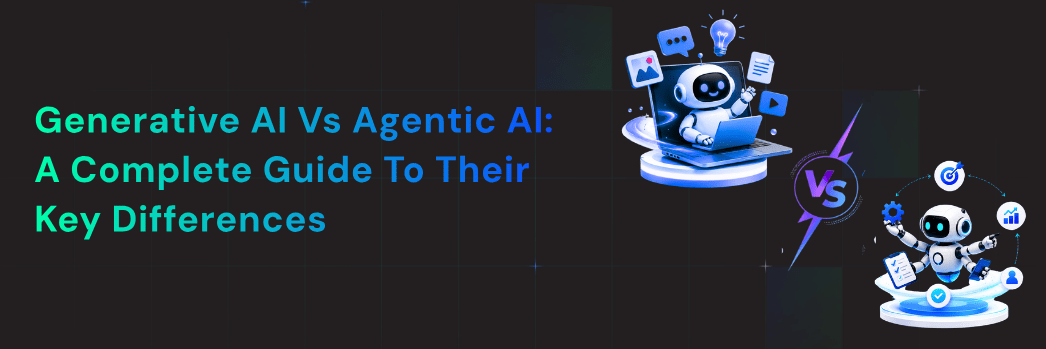
The key difference between generative AI and agentic AI is that generative AI is designed to make creative content, whereas agentic AI is meant to create and execute actions.
Generative AI is about generating content and responses to user prompts. Produces text, pictures, videos, etc., but doesn’t do much else but create content.
Agentic AI is rooted in a different paradigm: to actually make things happen for a goal. Instead of producing information, it can carry out functions, control processes, and run processes and workflows to achieve some desired effects.
Decision-Making Capabilities
Instead, generative AI is generally guided by human decision-making. It derivatively produces responses from its trained examples and needs input from its users for direction.
Recognising the need to make decisions, agentic AI is equipped with decision-making skills that enable it to analyse various alternatives and decide on the optimal course of action. Can process real-time data, adjust to changing situations, and make decisions to achieve goals efficiently.
This improved decision-making capability allows companies to automate more complex processes and to save manual oversight.
Level of Autonomy
One of the biggest differences between these AI technologies is the very low level of autonomy they offer.
In general, generative AI works within the boundaries of the user’s instructions. Needs prompting and explaining to make outputs but does not start actions.
Agentic AI has a greater independence. After objectives are set, it can decide on a plan to reach its objectives, engage with systems, and accomplish tasks with little manual input.
This makes agentic AI a valuable feature for organisations looking to utilise more advanced automation solutions.
User Interaction and Workflow
Generative AI is an iterative process involving user interactions. The user gives in prompts, gets outputs from them, and directs further action throughout all of it.
Agentic AI is workflow-oriented. Once it has been given goals or directions, it will execute two or more steps without further input from the user.
Agentic AI can be useful for businesses that are implementing advanced automation, as it can be used to automate entire workflows rather than just individual tasks.
Learning and Adaptability
The two technologies share similar elements of machine learning, but with distinct variations.
By learning patterns from huge amounts of data, generative AI technology is able to create more accurate and factual content with every use. But its adaptability tends to be confined to content-related tasks.
Agentic AI uses its continuous evaluation of outcomes combined with ongoing adjustments and changes in strategy and action to adapt to changing conditions. This dynamic adaptability enables it to operate successfully in complex settings with variable conditions.
In a rapidly changing marketplace, responding to shifting customer needs and requirements becomes a key benefit.
Task Execution Approach
Generative AI helps users create information and content that can help them accomplish tasks. The user still needs to implement the output that is generated.
Agentic AI: AI that takes an active role in doing things on the user’s behalf. Can perform actions, track progress, detect problems, and adjust independently.
The difference comes in especially great importance if your goal is to automate non-content-related processes.
Scalability and Business Impact
This is due to the difference in their effects: AI model 1 gives benefits in terms of scalability, and AI model 2 gives benefits in terms of time.
By leveraging generative AI, businesses can boost their content creation, customer interaction, and creativity. It can be used in the context of marketing campaigns, in content orientation, and in communication.
The integration of generative AI in these areas, like SEO services, search engine marketing, and digital content strategies, can enable companies to optimize their content creation processes, boost productivity, and support broader business objectives.
Agentic AI is designed to streamline operations, manage tasks, and support decision-making, leading to more efficient, large-scale operations. It can help cut down on operational expenses and boost productivity and responsiveness.
In the long run, agentic AI systems can handle campaign optimisation, reporting, and performance monitoring across various digital channels, potentially a long-term assistance for small business marketing campaigns interacting with the SEO agencies.
How to Choose Between Generative AI and Agentic AI
Choosing between generative AI and agentic AI will be based on the use case of a business and its needs, whether it be digital-friendly or not.
So, if your main task involves content creation, handling customer communications, customer marketing, or content creation, then generative AI might be the right one. Can also assist businesses in creating outstanding material conveniently and can aid in branding and promoting.
On the other hand, your organisation aims for workflow automation, process optimisation, independence in decision-making, and better operational efficiency. Agentic AI can be more advantageous with a long-term perspective.
Companies can enjoy a combination of these two technologies, and there can be many of them. Generative AI can generate content. Agentic AI can automate and take action on activities and workflows. Combined, they form an effective ecosystem to boost productivity, customer experiences, and business performance.
Organisations can benefit from using experienced AI development and digital transformation service providers to assess their company’s requirements, select the right AI solutions, and maximise the return on investment.

Conclusion
It is essential that businesses be aware of generative AI and understand the impact agentic AI can have in the age of AI development. Generative AI helps with the creation of content and assists users when creating information. Agentic AI makes decisions and acts autonomously.
Although both are abundant, they each have their virtues and are utilised for various business objectives. It’s the time for enhancements of creation, marketing, and communication that aren’t replaced by generative AI. It’s time to embrace the agentic in all workflow, efficiency, and automation endeavours for the purpose of assisting, not preventing.
Even though AI is on the horizon, it’s worth the time to understand the digital landscape and pick the best of the bunch for your business because they will keep you more productive, customer-friendly, and competitive. With the potential for content-driven AI solutions to advanced autonomous systems and more, investing in AI innovation today will make businesses more resilient to successful growth tomorrow.
Frequently Asked Questions
Q1. What is the main difference between generative AI and agentic AI?
Generative AI creates content such as text, images, and code, while Agentic AI autonomously plans, decides, and performs tasks to achieve goals.
Q2. Can generative AI and agentic AI work together?
Yes, generative AI can create content and insights, while agentic AI uses that information to make decisions and complete workflows.
Q3. Which industries benefit most from Agentic AI?
Healthcare, finance, manufacturing, logistics, retail, and customer service benefit significantly from Agentic AI through automation, efficiency, and smarter decision-making.
Q4. Is agentic AI more advanced than generative AI?
Agentic AI is generally considered more advanced because it can reason, plan, and act autonomously rather than only generating content.
Q5. How can businesses implement AI solutions effectively?
Businesses should identify clear objectives, choose suitable AI technologies, ensure data quality, and partner with experienced AI solution providers.
Search
Recent Post
- How AI in Mobile App Development Is Transforming Apps in Real Use
- Generative AI vs Agentic AI: A Complete Guide to Their Key Differences
- Accelerate UI/UX Prototyping with Design Systems in the USA
- Top 10 Mobile App Development Challenges Faced in the USA Market
- How to Choose the Best Mobile App Development Company in the UK
- Why PHP Web App Development Remains Ideal for Scalable Business Growth
Categories
- Digital marketing (14)
- E-Commerce Development (13)
- Mobile App Development (46)
- software development (4)
- UI/UX Design (6)
- Website Development (21)
You may also like
How AI in Mobile App Development Is Transforming Apps in Real Use Working with the Right Team Introduction Artificial Intelligence...

Generative AI vs Agentic AI: A Complete Guide to Their Key Differences Working with the Right Team Introduction The world...
Accelerate UI/UX Prototyping with Design Systems in the USA Working with the Right Team Introduction In the intensely competitive digital...