
The Future of Software Testing: How AI Is Transforming QA in 2026
- Miss. Lily
- 2 min read
Working with the Right Team
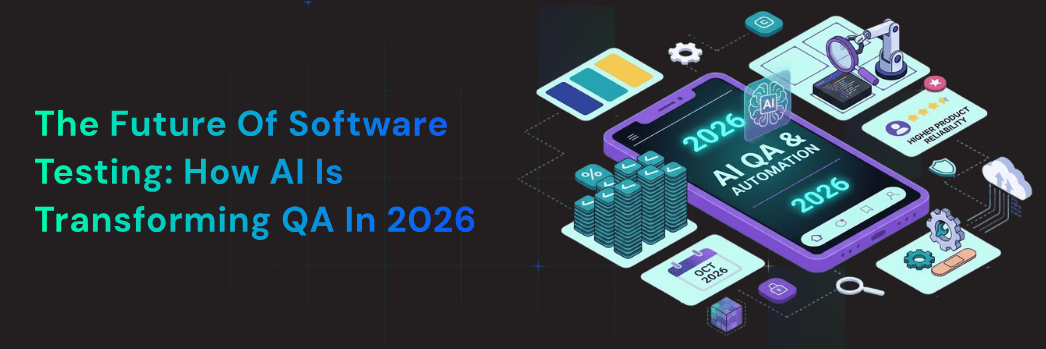
AI testing tools are no longer a competitive edge — they are the new baseline. For QA testers, IT teams, and software leaders worldwide, understanding how artificial intelligence is reshaping software quality assurance is no longer optional.
There was a time when software quality assurance meant a team of QA testers manually clicking through every screen, filling out spreadsheets, and hoping they’d caught every critical bug before release day. It was painstaking, time-consuming, and — despite everyone’s best efforts — never quite complete.
That era is ending. In 2026, AI in software testing has moved from experimental pilot programs to the backbone of quality assurance workflows at leading technology companies worldwide. And the implications for QA in IT — for individual QA testers, for engineering teams, and for the businesses that depend on reliable software — are profound.
At DigiAuxilio Technologies, a global custom app development company serving clients across India, the USA, the UK, New York, and markets around the world, we’ve seen firsthand how AI testing tools are transforming the quality and speed of software delivery. In this article, we break down what’s changing, why it matters, and what it means for the future of software quality assurance.
What Is AI in Software Testing — And Why Does It Matter Now?
AI in software testing refers to the application of machine learning, natural language processing, computer vision, and predictive analytics to the process of planning, executing, and evaluating software tests. Rather than relying solely on human QA testers to design test cases and manually verify outcomes, AI-powered systems can learn from historical data, generate tests automatically, identify high-risk areas of code, and continuously adapt to changes in the application under test.
The reason this matters intensely in 2026 is simple: software is getting harder to test. Applications are bigger, more interconnected, and more frequently updated than at any point in history. The rise of microservices architectures, continuous integration and deployment (CI/CD) pipelines, and multi-platform delivery means that software quality assurance teams face an exponentially larger testing surface than they did even five years ago — often with the same headcount.
Traditional test automation, which required QA testers to write and maintain thousands of brittle test scripts, was already struggling to keep pace. AI-powered testing doesn’t just automate — it adapts, learns, and scales in ways that rule-based automation never could.
“In 2026, the question is no longer whether to adopt AI testing tools. It’s how quickly your team can integrate them before your competitors do.”
A Complete Guide to QA Testing Types in 2026
Before diving into how AI transforms each stage, it’s worth mapping the full landscape of QA testing types that modern software teams rely on. Understanding where AI adds the most value requires understanding the testing workflow end to end.
| QA Testing Type | AI Automation Level | What It Tests | How AI Changes It |
| Unit Testing | Fully AI-Ready | Individual functions/modules | AI generates test cases automatically from code analysis |
| Integration Testing | Fully AI-Ready | Component interactions and APIs | AI maps dependencies and generates boundary-condition tests |
| Regression Testing | Fully AI-Ready | Existing features after code changes | AI prioritizes test suites by risk score; self-heals broken tests |
| Performance Testing | Fully AI-Ready | Speed, load, and scalability | AI predicts bottlenecks before they occur using pattern recognition |
| UI / Functional Testing | AI-Assisted | User interface and user flows | Computer vision identifies UI changes; AI updates test selectors automatically |
| Security Testing | AI-Assisted | Vulnerabilities and exploits | AI scans code for vulnerability patterns; learns from new threat data continuously |
| Accessibility Testing | AI-Assisted | WCAG compliance, screen reader compatibility | AI audits interfaces against accessibility standards at scale |
| Exploratory Testing | Human-Led | Unscripted, intuitive UX testing | AI assists with session recording and anomaly flagging; human insight remains critical |
| User Acceptance Testing (UAT) | Human-Led | Business requirements validation | AI generates scenario suggestions; human QA tester validates business logic |
| Compatibility Testing | Fully AI-Ready | Cross-device and cross-browser behavior | AI runs parallel tests across device matrices with visual diff reporting |
This overview reveals a clear pattern: AI testing tools excel at repetitive, pattern-based, high-volume testing tasks. Human QA testers continue to lead in areas requiring business context, creative thinking, and genuine user empathy. The best software quality assurance programs in 2026 deploy both intelligently.
The Top AI Testing Tools Reshaping QA in IT
The market for AI testing tools has exploded in recent years. What follows is a breakdown of the categories and leading platforms that QA teams in IT are integrating into their workflows in 2026.
Testim
AI Test Authoring
Uses machine learning to create and maintain stable UI tests that self-heal when the application changes, eliminating the brittleness of traditional selector-based tests.
Mabl
Intelligent Test Automation
Integrates with CI/CD pipelines and uses AI to detect visual and functional regressions automatically across web applications with minimal configuration.
Applitools
Visual AI Testing
Leverages computer vision to compare UI screenshots with pixel-perfect accuracy, identifying visual bugs that traditional functional tests completely miss.
Tricentis Tosca
Enterprise QA Platform
An enterprise-grade test automation platform with AI-powered risk-based test optimization that prioritizes the tests most likely to catch defects in each release.
Functionize
NLP-Powered Testing
Allows QA testers to write test cases in plain English using natural language processing, dramatically lowering the technical barrier to test authoring.
BrowserStack AI
Cross-Platform Testing
Uses AI to intelligently select which device and browser combinations to prioritize for each test run, reducing execution time by up to 70% without sacrificing coverage.
DigiAuxilio provides end-to-end software quality assurance and AI-powered testing integration for clients across India, USA, UK, New York, UAE, and Canada. Whether you need a complete QA audit, test automation architecture design, or an AI testing tools implementation roadmap — our global team of QA testers and software engineers delivers results at enterprise quality, startup speed.
How AI Is Changing the Role of the QA Tester
Perhaps the most discussed — and most misunderstood — aspect of AI in software testing is what it means for the human QA tester. The fear that AI will replace QA roles entirely misses a more nuanced and ultimately more optimistic reality.
AI is not eliminating the need for skilled QA testers. It is fundamentally changing what excellent QA work looks like — and elevating the function in the process. The QA testers who thrive in 2026 are those who have shifted from executing manual scripts to designing intelligent testing systems. From writing test cases to owning test strategy. From reactive bug-finding to proactive quality engineering.
The Emerging QA Tester Skillset in 2026
- AI tooling literacy: Understanding how to configure, train, and maintain AI testing platforms like Testim, Mabl, and Applitools
- Test strategy architecture: Designing the overall testing pyramid — deciding what to automate, what to AI-assist, and what requires human-led exploratory testing
- Data analysis and reporting: Interpreting AI-generated test results, coverage reports, and defect prediction models for engineering and product stakeholders
- Shift-left quality thinking: Embedding quality gates earlier in the development cycle, working alongside developers from requirements definition through to release
- Security and performance QA: Specializing in the areas where AI assists rather than fully automates — where human expertise drives the most value
- Cross-platform expertise: Validating software behavior across mobile (Android, iOS), web, and API layers — an increasingly critical skill in multi-platform delivery environments
“The QA tester of 2026 is not someone who runs tests. They are someone who builds, owns, and continuously improves an intelligent quality system that runs tests for them.”
AI-Driven Software Quality Assurance: The Business Case
For business leaders and IT managers who need to justify investment in AI-powered software quality assurance infrastructure, the business case is compelling and measurable.
Faster Time to Market
Traditional regression testing cycles can take days or weeks. AI-powered test suites with intelligent prioritization can reduce that to hours — enabling more frequent releases, faster iteration cycles, and the ability to respond to market changes without being bottlenecked by a slow testing process. For competitive industries — fintech, e-commerce, healthcare technology, SaaS — this velocity advantage compounds significantly over time.
Dramatically Reduced Defect Escape Rates
AI testing tools that use predictive analytics can identify which areas of code carry the highest defect risk based on historical patterns, code complexity metrics, and change frequency. By concentrating test resources on the highest-risk areas, teams consistently catch more bugs before they reach production — reducing the cost of defect remediation, which is exponentially higher post-release than pre-release.
Lower Long-Term QA Costs
While the initial investment in AI-powered QA in IT infrastructure requires upfront commitment, the total cost of quality typically decreases significantly over time. Self-healing tests eliminate the hours QA testers previously spent maintaining brittle automation scripts. AI-generated test cases reduce the manual effort of test design. And proactive defect prevention reduces the emergency engineering costs of production incidents.
Better Coverage at Scale
One of the most practical advantages of AI in software testing is the ability to achieve genuinely comprehensive coverage across complex systems. A human QA team has inherent capacity limits — AI testing systems do not. They can run thousands of test scenarios in parallel across every supported platform, browser, and device configuration simultaneously, providing coverage that no manual team could match regardless of headcount.
Need expert QA and software testing services for your product?
DigiAuxilio serves clients across India, USA, UK, New York & worldwide with end-to-end software quality assurance.
Implementing AI in Software Testing: A Practical Roadmap
For teams ready to modernize their software quality assurance practice with AI, the path forward is clearer than it might appear. Here’s the implementation framework DigiAuxilio recommends for clients at every stage of digital maturity.
01 Audit Your Current QA Baseline
Before introducing AI testing tools, understand where you are. Map your existing test coverage, identify your most painful manual testing bottlenecks, and establish baseline metrics for defect escape rates, release frequency, and test execution time. You need a baseline to measure ROI accurately.
02 Identify the Highest-Value AI Automation Targets
Not every test is worth automating with AI. Focus first on your highest-frequency regression tests — the suite you run on every commit. These have the highest volume, the clearest ROI, and the most to gain from self-healing AI automation. This is where the payback is fastest.
03 Select and Pilot the Right AI Testing Tools
Run a structured pilot with two or three AI testing platforms against your target test suite. Evaluate on accuracy, maintenance burden, CI/CD integration quality, reporting depth, and total cost of ownership — not just feature lists. The tool that fits your tech stack and your team wins.
04 Upskill Your QA Tester Team
Invest in training for your existing QA testers on AI tooling, test strategy design, and data analysis. The teams that succeed fastest with AI in software testing are those that bring their human experts along — not those that try to replace them. Your QA team’s domain knowledge is the fuel that makes AI-generated tests meaningful.
05 Integrate QA Left — Into Your CI/CD Pipeline
Shift quality checks as early as possible in the development lifecycle. Connect your AI testing tools directly to your CI/CD pipeline so that every code commit triggers an intelligent test run, defect risk assessment, and coverage report. Quality becomes continuous, not periodic.
06 Measure, Learn, and Continuously Improve
Track your key metrics — defect escape rate, test execution time, release frequency, post-release incidents — before and after AI adoption. Use this data to continuously refine your AI models, expand coverage, and demonstrate business value to stakeholders. Quality engineering is a discipline of continuous improvement, not a one-time implementation.
The Global Perspective: AI-Powered QA Across Markets
One of the most important developments in software quality assurance in 2026 is how AI testing tools are democratizing access to enterprise-grade QA practices for teams in every market — not just the large technology hubs of Silicon Valley or London.
In India — home to one of the world’s largest and most sophisticated software engineering ecosystems — AI in software testing is accelerating an already strong tradition of QA excellence. Indian development teams, long recognized for their depth in manual and automated testing, are rapidly integrating AI capabilities to deliver even higher quality at even greater velocity for global clients.
In the USA and New York specifically, enterprises in financial services, healthcare, retail, and media are investing heavily in AI-powered QA infrastructure as part of broader digital transformation programs. The demand for QA testers with AI tooling expertise has surged, and the gap between teams that have adopted modern AI testing practices and those that haven’t is becoming increasingly visible in product quality and release velocity.
In the UK, regulatory requirements in industries like fintech, insurance, and healthcare are driving investment in more rigorous, auditable quality assurance processes — areas where AI-powered testing with comprehensive reporting and traceability is particularly well-suited to meet compliance demands.
At DigiAuxilio Technologies, with offices and clients across all these markets, we see the full picture of how AI in software testing is unfolding globally — and the consistent truth is that teams that act now build an advantage that compounds over time.

Build Software That Works Flawlessly
DigiAuxilio delivers custom app development, web development, and software quality assurance services to clients across India, the USA, the UK, New York, UAE, and worldwide. Let’s talk about how AI-powered QA can transform your software delivery.
Search
Recent Post
- How AI in Mobile App Development Is Transforming Apps in Real Use
- Generative AI vs Agentic AI: A Complete Guide to Their Key Differences
- Accelerate UI/UX Prototyping with Design Systems in the USA
- Top 10 Mobile App Development Challenges Faced in the USA Market
- How to Choose the Best Mobile App Development Company in the UK
- Why PHP Web App Development Remains Ideal for Scalable Business Growth
Categories
- Digital marketing (14)
- E-Commerce Development (13)
- Mobile App Development (46)
- software development (4)
- UI/UX Design (6)
- Website Development (21)
You may also like
How AI in Mobile App Development Is Transforming Apps in Real Use Working with the Right Team Introduction Artificial Intelligence...

Generative AI vs Agentic AI: A Complete Guide to Their Key Differences Working with the Right Team Introduction The world...
Accelerate UI/UX Prototyping with Design Systems in the USA Working with the Right Team Introduction In the intensely competitive digital...