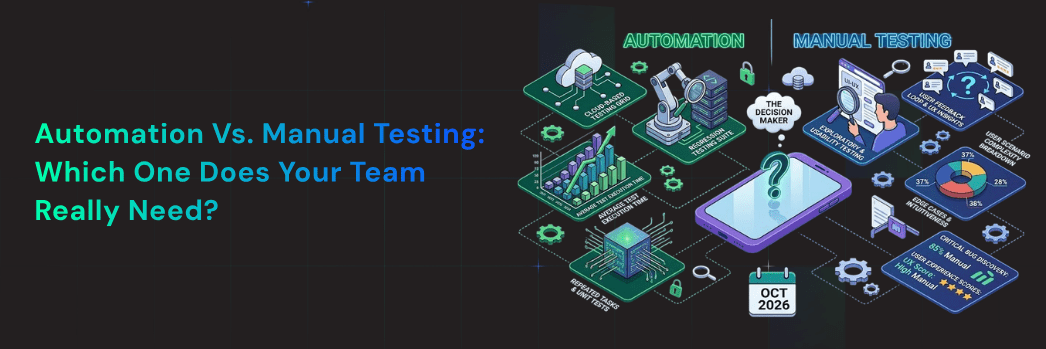
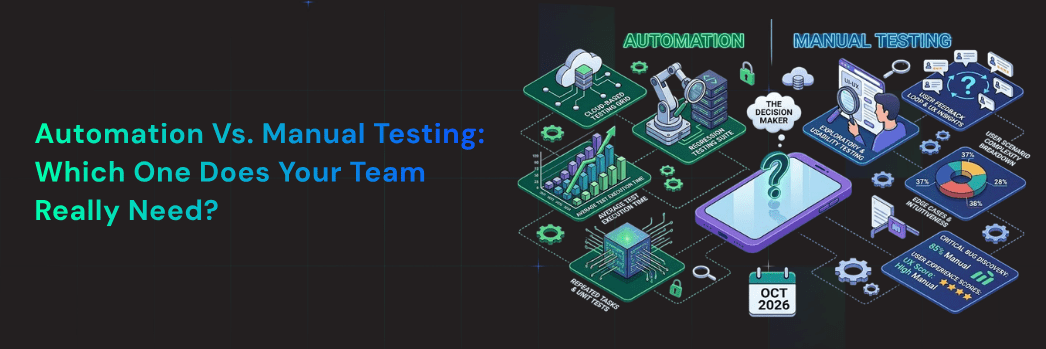
Delivering high-quality software is essential for business success. Whether you are building a mobile app, web application, or enterprise software, QA software testing plays a critical role in ensuring your product works smoothly and provides the best user experience.
One of the most common questions development teams face is: Should we use Automation Testing or Manual Testing? Both approaches are valuable in software quality assurance, but choosing the right one depends on your project goals, timelines, and complexity.
In this article, we’ll explore the differences between Automation Testing and Manual Testing, their benefits, and how to decide which testing approach your team really needs.
Understanding QA Software Testing
QA (Quality Assurance) software testing is the process of evaluating software applications to ensure they meet quality standards, functionality requirements, and performance expectations.
The main objectives of QA testing include:
Identifying bugs and errors in the application
Ensuring the software performs as expected
Improving user experience
Preventing costly issues after product launch
QA testing is generally divided into two primary approaches:
Manual Testing
Automation Testing
Let’s explore both in detail.
What is Manual Testing?
Manual Testing is the process where testers execute test cases manually without using automated tools or scripts. Testers interact with the software like real users, checking functionality, usability, and overall performance.
Key Features of Manual Testing
Tests are executed by human testers
No automation tools are required
Ideal for exploratory and usability testing
Flexible and adaptable to changes
Benefits of Manual Testing
Better Human Observation Manual testers can detect UI issues, design inconsistencies, and user experience problems that automated scripts may miss.
Ideal for Exploratory Testing When software features are new or frequently changing, manual testing allows testers to explore different scenarios easily.
Cost-Effective for Small Projects For small applications or short-term projects, manual testing may be more affordable than setting up automation frameworks.
4. Flexible Testing Approach Testers can quickly modify testing strategies without rewriting automation scripts.
Limitations of Manual Testing
Time-consuming for large projects
Higher chance of human error
Difficult to repeat large numbers of tests
Slower feedback during development cycles
Because of these limitations, many companies combine manual testing with automation testing.
What is Automation Testing?
Automation Testing uses specialized tools and scripts to automatically execute test cases and verify software functionality.
Instead of manually checking every feature, automation scripts perform repetitive testing tasks quickly and accurately.
Key Features of Automation Testing
Uses tools like Selenium, Cypress, or Appium
Executes tests automatically
Suitable for repetitive testing tasks
Ideal for regression and performance testing
Benefits of Automation Testing
Faster Testing Process Automation testing significantly reduces the time required to run repetitive tests.
Higher Accuracy Automated scripts eliminate human errors and provide consistent test results.
Reusable Test Scripts Automation scripts can be reused across multiple development cycles, saving time and effort.
Continuous Integration Support Automation testing works well with CI/CD pipelines, allowing teams to test software continuously during development.
Scalable Testing for Large Applications Automation makes it easier to test complex systems with thousands of test cases.
Limitations of Automation Testing
Initial setup cost can be high
Requires skilled automation engineers
Not suitable for usability testing
Script maintenance is required when software changes
Key Differences Between Automation Testing and Manual Testing
Feature
Manual Testing
Automation Testing
Execution
Performed by human testers
Executed by automated scripts
Speed
Slower
Much faster
Accuracy
Possible human errors
Highly accurate
Cost
Lower initial cost
Higher initial investment
Best Use
Exploratory & usability testing
Regression & repetitive testing
Both testing methods play an important role in QA software testing, and many organizations use a hybrid testing strategy.
When Should Your Team Use Manual Testing?
Manual testing is the best option when:
Your project is small or in early development stages
You need exploratory testing
User experience and design testing are important
Features change frequently
Manual testing helps teams understand how real users interact with the application.
When Should Your Team Use Automation Testing?
Automation testing is ideal when:
Your application requires frequent testing
The project has repetitive test cases
You want faster release cycles
Continuous integration is part of your workflow
Automation testing helps companies deliver software faster while maintaining quality.
The Best Approach: A Balanced Testing Strategy
Instead of choosing only automation testing or manual testing, most successful companies combine both methods.
A balanced QA software testing strategy may look like this:
Manual testing for usability and exploratory testing
Automation testing for regression and repetitive tasks
This hybrid approach allows development teams to maintain software quality while improving testing efficiency.
How Professional QA Services Can Help
Choosing the right testing strategy can be challenging without experienced professionals. Working with a specialized QA team ensures your application is thoroughly tested before launch.
Companies like Digiauxilio provide expert QA software testing services, including manual testing, automation testing, performance testing, and quality assurance consulting. Their experienced testers help businesses identify issues early and deliver reliable, high-performance software products.
If you want to improve your product quality and testing efficiency, partnering with an expert QA team can make a significant difference.
1. What is the main difference between automation testing and manual testing?
Manual testing is performed by human testers without tools, while automation testing uses scripts and software tools to execute test cases automatically.
2. Is automation testing better than manual testing?
Not necessarily. Both have their advantages. Automation testing is faster for repetitive tasks, while manual testing is better for usability and exploratory testing.
3. Can small businesses benefit from automation testing?
Yes, but it depends on the project size. For smaller projects with limited test cases, manual testing may be more cost-effective.
4. What types of testing are usually automated?
Regression testing, performance testing, load testing, and repetitive functional tests are commonly automated.
5. Should companies use both manual and automation testing?
Yes. A combination of manual and automation testing provides the most effective QA software testing strategy and ensures higher software quality.
Tailored App Development Solutions: How Personalized Apps Drive Better Business Results Working with the Right Team In today’s hyper-competitive digital...