
How Artificial Intelligence is Shaping E-Commerce Growth in 2026
- Miss. Lily
- 2 min read
Working with the Right Team
Introduction
Artificial intelligence, the digital commerce sector is changing faster than ever! By 2026, businesses are increasingly turning to technologies that provide intelligence – for better experiences with customers, improved automation, and enhanced e-commerce growth. Leveraging AI in online retailing is now one of the most valuable tools for modern retailers, with personalized shopping experiences, automated logistics, and more.
With the continuing surge of competition in the online space, businesses are looking for more productive methods to bring in and keep customers. Brands can use AI solutions to gain insights into customer behavior, forecast purchasing patterns, and optimize their business operations. From a small startup to a big enterprise, modern e-commerce businesses are pouring a lot of resources into advanced technologies to keep a competitive edge in the market.
AI has become a game-changer in the world of e-commerce, providing a distinct edge for businesses that are leveraging its capabilities in their online platforms these days and, when matched with seasoned technology partners, professional e-commerce development services. Intelligent solutions that boost business performance and customer satisfaction are the keys to the future of online retail, alongside a beautiful website.
The Rise of AI in Modern E-Commerce
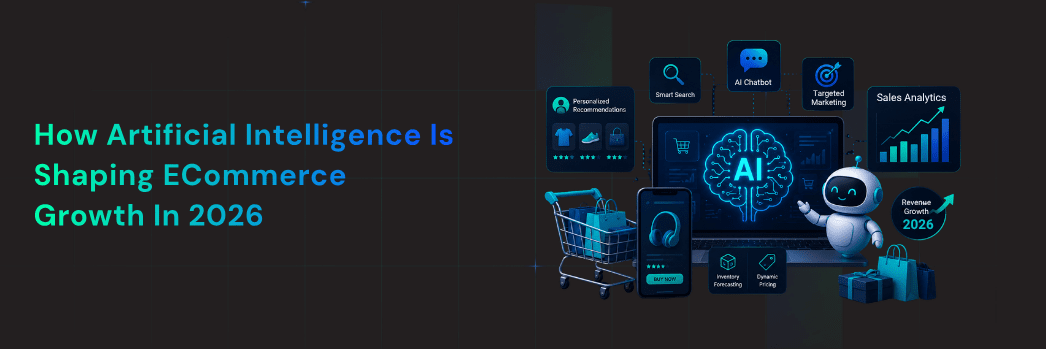
AI is a key pillar of online retail today. AI-driven solutions are currently used in businesses to analyze customer information, enhance product listings, optimize search capabilities, and automate customer engagement. This change in technology has contributed to e-commerce growth at a faster pace globally.
To harness the power of the Internet, many companies are turning to an experienced e-commerce development company to develop high-end e-commerce platforms with AI technology. These platforms can help businesses perform repetitive tasks automatically and provide more personalized and precise customer experiences.
The use of AI elements like predictive analytics, machine learning algorithms, recommender systems, and automated stock systems has become a key priority in the development of a modern e-commerce website. With the shift in the e-commerce landscape, AI helps companies be agile and adjust to customer needs and market changes.
With the help of an expert e-commerce website developer, it is now possible to design intelligent e-commerce stores that don’t just look cool but function intelligently and include AI-powered automation. This completely transformed business operations in 2026 in the online sector.
How AI Improves Customer Experience in E-Commerce
For online retailers, customer experience is one of the most important factors of successful online retail strategies. Overall, artificial intelligence enables businesses to enhance the customer experience generated by their sales agents, providing faster, smarter, and more personalized shopping experiences that lead to improved levels of customer satisfaction and conversions.
Personalised Product Recommendations
AI-driven recommendation engines look at the browsing history, the likes of your clients, your purchases, and your search behaviors and suggest very relevant items. This particular customer-centered procedure drives more time spent on online stores and more buying chances for the customers.
Professional e-commerce development solutions are now being used by many companies, where they have started to incorporate recommendation engines directly into the system. These AI-powered systems guide customers towards products efficiently while also optimizing e-commerce growth as well as retaining customers through their shopping journey.
Many online giants have already demonstrated the importance of personalized recommendations in improving sales and customer engagement.
AI Chatbots and Virtual Assistants
AI chatbots are now a crucial component of the digital marketing landscape in today’s eCommerce world. These smart bots can automatically respond to customer inquiries, answer product questions, manage orders, and guide customers through the purchasing process.
AI chatbots don’t have to wait until paying customers have free time; they are ready to assist 24/7, seven days a week. By utilizing an experienced e-commerce development company, companies have the ability to include advanced virtual aids that boost reaction times and lessen customer aggravation.
Additionally, AI-powered customer service reduces the resources consumed without sacrificing the satisfaction of the customers. Improved customer support leads to better customer loyalty and increased conversions; there’s nothing that is more clear-cut than that.
Voice Search and Smart Shopping
Voice shopping is poised to keep accelerating in 2026. Purchasers are increasingly turning to smart devices and voice assistants to find products, compare the prices, and order online from the customer.
Businesses can use AI tech to optimize the search of their products for natural language or voice recognition. Amidst the growing awareness of the significance of accessibility and convenience in web development, businesses are concentrating on making their online platforms work perfectly with the latest voice search technology. With globalization, the need for online platforms to be compatible with voice search technology has become more and more prominent, making online companies more attentive towards doing business in such a way that you can use speech.
Smart shopping technologies also make shopping online faster and simpler and provide instant recommendations to customers based on their shopping patterns.
AI-Powered Marketing Strategies for E-Commerce Growth
The whole functional area of digital marketing has been revolutionized by artificial intelligence for online businesses. AI-powered marketing enables businesses to target their customers more precisely and enhance the performance of marketing campaigns using data.
Predictive Customer Analytics
Predictive analytics is a type of AI system that can predict customer behavior and make informed predictions about future buying habits. This aids businesses in identifying what products customers are least likely to buy and when they are ready to buy these products.
With predictive insights, companies can optimize product promotions, customer retention strategies, and inventory planning, optimizing their e-commerce website development agency solutions.
Predictive customer analytics can further enable companies to build more personalized marketing strategies that lead to improved engagement and conversion rates.
Automated Email and Advertising Campaigns
Email marketing and advertising now have an AI-powered automation solution, which can run them extremely precisely. Such systems automatically split the audience and schedule campaigns, as well as customize messages based on pattern recognition.
In line with this, numerous businesses that are investing in e-commerce website development firms will additionally include an automatic marketing system on their websites to make things with customers and efficiency easier.
Another benefit of using AI in advertising is the increase in ROI, as it can target the right person at the right time with the most relevant ads. This enhances the effectiveness of marketing campaigns and eliminates unnecessary marketing costs.
Social Media and AI Integration
AI algorithms are now used in social media platforms to make content and advertising more relevant to their target audience. AI tools have been employed online to study social media interaction, buyer tastes, and trending subjects. AI tools are really being applied to online retailers to determine customer pursuits, social media interaction, and trending subjects.
AI-powered social commerce solutions can be embedded into the platform by an experienced e-commerce web design company, enhancing customer engagement across various platforms. Social communication within business is now automated, and companies can use customer feedback to optimize their advertisements and strategies more effectively.
In recent years, the adoption of artificial intelligence (AI) in social media marketing has emerged as one of the most influential factors in the growth of e-commerce. AI is now a major catalyst for the advancement of modern e-commerce growth, specifically in social media marketing.
The Impact of AI on Inventory and Supply Chain Management
AI is also reshaping the way online retailers do business. AI systems enable businesses to enhance their inventory management, minimize waste, and streamline the flow of supply chain management processes.
Smart Inventory Forecasting
AI-driven forecasting systems look at sales patterns, customer needs, and seasonal trends to forecast accurate inventory requirements. This may assist the business in keeping their inventory at the optimal level and prevent them from overstocking or running out of items.
Incorporating inventory automation on mobile and web apps has become critical for businesses to streamline operations. Businesses increasingly seek eCommerce app development services these days, and one main focus is on automating their inventory in mobile and web apps.
Making correct forecasts leads to better customer satisfaction and lower storage and inventory expenses.
AI in Logistics and Delivery Services
AI is transforming the field of logistics and delivery, with enhanced delivery scheduling, shipment tracking, and route optimization. With intelligent automation, the time required for businesses to complete their deliveries has been cut down, resulting in better customer experiences.
To enhance customer convenience and transparency, the companies involved in e-commerce mobile app development are also introducing delivery tracking features that are based on real-time technology driven by artificial intelligence.
It explains how effective logistics systems play an important role in both operations and customer satisfaction.
Automated Order Management
AI-powered order management solutions automate the handling of orders, payments, inventory management, and shipping coordination. This will save manual effort and decrease human errors.
An enterprise that’s making use of superior e-commerce growth technologies can handle massive volumes of orders that are both processed quickly and correctly and delivered on time.
The automation solution helps in increasing the operational productivity as well as supports the business for the long term.
Benefits of Artificial Intelligence for E-Commerce Businesses
AI could provide some benefits to business growth and long-term success in e-commerce, which seem to fit e-commerce perfectly. These benefits of AI align with e-commerce to a tee, and here are a handful of them that directly impact business growth and long-term success.
Increased Sales and Revenue
This AI technology enhances businesses’ ability to generate more conversions and boost the average order value through recommendation systems and personalization. Consumers are getting more shopping-relevant experiences, which results in better purchase decisions.
With the assistance of a dependable e-commerce development company, companies can utilize AI tools that can substantially boost general sales effectiveness.
Reduced Operational Costs
Customer service is the area where repetitive work is eliminated thanks to automation, as well as in inventory management and marketing operations. This will enable businesses to run more efficiently and save on the costs of employees and operations.
AI systems help to reduce expensive mistakes and enhance work management in various business areas.
Enhanced Business Decision-Making
AI offers comprehensive and informative data analysis, enabling businesses to make informed strategic decisions. Customer behavior analysis, market forecasting, and more – AI tools can enhance business planning for long-term growth strategies.
With professional eCommerce development solutions, your business receives improved visibility into customer trends and performance.
Future Trends of AI in E-Commerce
The possibilities for AI in online retail are very exciting. Over the next few years, companies will embrace tech like augmented reality retail, hyperpersonalization, visual search, and intelligent automation systems, all powered by AI.
AI-powered virtual shopping assistants will be more advanced, providing customers instant guidance and personalization on products. These machine-learning algorithms will continue enhancing how the company targets customers, costs, and efficiency.
Innovative e-commerce website development service providers will help their businesses become future-ready in aligning with the new technologies and customer needs. As a result, AI will remain a key component in promoting E-commerce growth, transforming the sector to offer a better customer experience, remain efficient, and stay competitive in the e-commerce arena.

Conclusion
AI is transforming the eCommerce landscape in 2026 in ways people’s heads could never have imagined. In 2026, artificial intelligence is playing an incredible part in changing the landscape of e-commerce online. Witnessing personalized shopping experiences and automated supply chain management systems are merely exercises and examples of how AI is proving to be a force for innovation and business success.
Companies that use AI technologies in their eCommerce operations are creating better customer experiences, boosting efficiency, and enjoying better long-term results. As companies make stronger investments in expert e-commerce growth, clever automation, and complex digital answers, they’re outfitting a big competitive edge against the changing online market. With expert e-commerce development, clever automation, and advanced digital solutions, businesses are gaining a massive competitive benefit in the dynamic online market.
However, with the ongoing evolution of technology, AI is poised to continue playing a pivotal role in the future of e-commerce growth, empowering businesses to deliver more intelligent, efficient, and customer-centric e-commerce experiences.
Frequently Asked Questions
Q1. What will be the impact of AI in 2026?
AI in 2026 will improve automation, customer experiences, data analysis, productivity, and decision-making, helping businesses grow faster and operate more efficiently worldwide.
Q2. How is artificial intelligence transforming the e-commerce industry?
Artificial intelligence transforms e-commerce through personalized recommendations, smart chatbots, automated inventory management, predictive analytics, and improved customer support for better shopping experiences.
Q3. What are the 4 types of e-commerce?
The four main types of e-commerce are Business-to-Business (B2B), Business-to-Consumer (B2C), Consumer-to-Consumer (C2C), and Consumer-to-Business (C2B).
Q4. What are the latest e-commerce trends?
Latest e-commerce trends include AI-powered shopping, voice search, mobile commerce, social commerce, personalized experiences, fast delivery services, and sustainable online shopping practices.
Q5. What are common eCommerce business mistakes?
Common eCommerce mistakes include poor website design, slow loading speed, weak customer support, ignoring SEO, complicated checkout processes, and ineffective marketing strategies.
Search
Recent Post
- How AI in Mobile App Development Is Transforming Apps in Real Use
- Generative AI vs Agentic AI: A Complete Guide to Their Key Differences
- Accelerate UI/UX Prototyping with Design Systems in the USA
- Top 10 Mobile App Development Challenges Faced in the USA Market
- How to Choose the Best Mobile App Development Company in the UK
- Why PHP Web App Development Remains Ideal for Scalable Business Growth
Categories
- Digital marketing (14)
- E-Commerce Development (13)
- Mobile App Development (46)
- software development (4)
- UI/UX Design (6)
- Website Development (21)
You may also like
How AI in Mobile App Development Is Transforming Apps in Real Use Working with the Right Team Introduction Artificial Intelligence...

Generative AI vs Agentic AI: A Complete Guide to Their Key Differences Working with the Right Team Introduction The world...

Accelerate UI/UX Prototyping with Design Systems in the USA Working with the Right Team Introduction In the intensely competitive digital...