
The Impact of AI in Mobile App Development on Modern Apps
- Miss. Lily
- 2 min read
Working with the Right Team
Introduction
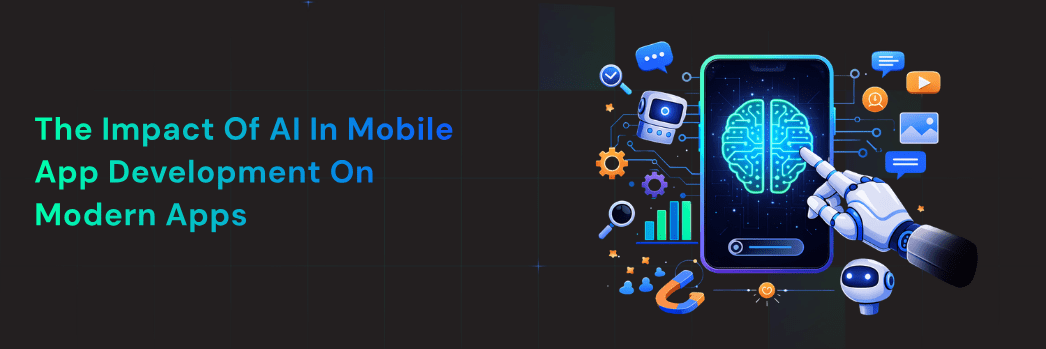
Artificial Intelligence (AI) is quickly transforming the digital environment, and its impact on mobile app development cannot be denied. The new applications are not merely a tool anymore but an intelligent platform that learns user behavior and anticipates needs and gives custom experiences. Companies in all industries are turning to the concept of AI in their mobile application development plans in order to remain competitive and relevant.
Startups and well-established businesses can use AI in the development of their apps to create smarter, faster, and more efficient applications. It is either in Android app development or cross-platform solutions, but in any case, AI-driven functions are reinventing the way apps operate and how people engage with them. This change is not just improving user satisfaction but also delivering quantifiable business results.
Key Benefits of AI in Mobile App Development
Enhanced User Experience
The possibility to provide users with very personalized experiences can be considered one of the greatest benefits of AI in mobile application development. AI algorithms process user behavior, preferences, and interactions to provide real-time content and suggestions.
Voice assistants, chatbots, and predictive search are some of the features that make the interface easier to use and interact with. As an example, chatbots powered by AI as part of apps can offer immediate customer service, enhancing response time and cutting business operation expenses. This degree of personalization is particularly useful to businesses that provide solutions of app development services since this directly influences retention and satisfaction by users.
Improved App Performance
AI is essential in app optimisation. Machine learning algorithms allow applications to track performance indicators and notable bottlenecks and make real-time adjustments to maintain a smooth operation.
To a mobile app development firm, the use of AI would be to develop applications that are faster and more reliable. AI is also used to allocate resources efficiently, saving battery usage and loading faster. This will lead to improved performance of the app on various devices, especially in Android application development, where fragmentation of devices may be a problem.
Advanced Security Features
The issue of security is significant in the current development of apps, and AI has strong solutions to resolve this issue. Intelligent systems based on AI are capable of identifying suspicious patterns, detecting any possible threat, and preventing security attacks in real time.
Some of the advanced capabilities that AI enables include biometric authentication, fraud detection, and behavior-based security. In the case of any business that collaborates with an app development agency, the integration of AI-based security will provide protection to data and generate trust in users. This is especially significant in the case of fintech, healthcare, and e-commerce applications.
Real-World Applications of AI in Mobile Apps
AI has already become a common practice in different industries, changing the way mobile applications work. In e-commerce, AI-based recommendation systems can be used to improve the conversion rate by analyzing user preferences and recommending the products. The use of AI-enabled apps in healthcare can be in diagnostics, monitoring patients, and virtual consultations.
AI is applied in navigation apps to give real-time traffic information and route optimization and is used in social media to curate and moderate content. In the case of Android application development, AI is also being applied to improve camera features, voice recognition, and image processing.
Companies that cooperate with the top app development firms are going to greater lengths of applying AI to develop innovative solutions. These practical uses show that AI is not a secondary feature but an essential part of contemporary app development.
How AI Is Transforming Mobile App Development Process
Automated Development & Testing
The method of AI is simplifying the process of developing an app by the automation of repetitive activities. AI-powered tools are enhancing efficiency and shortening the development time, starting with code generation up to bug detection.
Another AI field that is being impacted is automated testing. AI software may model user behavior, spot bugs, and propose solutions without a human operator. This especially helps when mobile app development software is being used by a team because more productivity and quality applications will be guaranteed. In case startups are in need of the most suitable app developers of startups, AI-driven automation will lower the costs and shorten time-to-market, simplifying the launch of competitive products.
Data-Driven Decision Making
With the help of AI, developers and businesses can make well-informed decisions with data insights. Through user behavior analysis, application usage patterns, and market trends, AI can also give actionable information that can be used to guide development strategies.
This data-driven method assists in prioritization of features, performance, and user experience optimization. To any app development company, the use of AI analytics can help it make decisions that are supported by actual facts and not presumptions.
Also, AI assists in A/B testing and user segmentation so that businesses can optimize their applications over time. This increases the return on investment and engagement in projects of mobile application development.
Challenges of Implementing AI in Mobile Apps
Although AI integration in mobile apps has many advantages, a set of challenges is also associated with it. The high cost of development is one of the major concerns. AI technology needs specialized expertise, infrastructure, and resources that may be costly to small businesses.
The problem of privacy and security of data is also of the utmost importance. Artificial intelligence systems are very dependent on the data of the user, and it is crucial that the data protection laws be adhered to. These issues should be tackled by having a trusted mobile app development firm.
The complexity of AI integration is also another issue. The creation and upkeep of AI models requires constant updates and monitoring. In the case of most organisations, locating the appropriate expertise in the development of AI apps may be a major challenge.
Finally, performance problems can also emerge due to the failure to optimize AI capabilities. Intense AI usage may affect the performance of apps, particularly on cheaper devices. Thus, it is important to plan and implement.
Future Trends of AI in Mobile App Development
The future of AI in mobile app development is bright, and there are various trends that are emerging to dominate the industry. Another major trend is the emergence of hyper-personalisation, with the apps becoming even more personalised with real-time data.
Voice and conversational interfaces will be improved, making the interaction between users and applications easy. AI-based augmented reality (AR) and virtual reality (VR) will also become popular, especially in the fields of gaming, retail, and education.
Another important trend is the combination of AI and the Internet of Things (IoT), which enables applications to operate and communicate with smart devices. This will create new possibilities for the businesses that provide the app development service solutions.
AI-based low-code and no-code platforms will streamline the development process and allow it to be accessible to non-technical users. This will stimulate more companies to invest in the development and innovation of mobile applications.
To keep up with the competition, it will be necessary to engage the top app developing firms and make use of the most sophisticated mobile app development software.

Conclusion
AI is changing the face of mobile app development, allowing companies to develop smart, efficient, and user-friendly applications. The effects of AI are extensive and even more significant in the context of user experience and performance, as well as in strengthening security and automating processes.
Although there are issues like cost and complexity, the advantages of AI integration heavily outweigh the disadvantages. Companies that adopt AI-based app development are in a better position to be innovative, competitive, and expand in the current digital economy.
Be it a startup or an already-developed enterprise, investing in the creation of AI applications with a reputable mobile app developer company or app development agency will help open new opportunities and achieve long-term success. With technology going on, it can be stated that AI will keep being the leading type of innovation in the future of mobile applications.
Frequently Asked Questions
Q1. How is AI changing mobile apps today?
AI is making mobile apps smarter by enabling personalization, chatbots, and real-time recommendations, helping businesses deliver faster, more relevant, and engaging user experiences.
Q2. Why is AI important for mobile apps in 2026?
AI is essential in 2026 because it keeps apps competitive, improves speed and functionality, and helps deliver smarter, more personalized user experiences across platforms.
Q3. Why are mobile apps becoming more interactive?
Mobile apps are becoming more interactive due to real-time responses, live chat features, and intelligent systems that enhance engagement and improve overall user experience.
Q4. What is making apps more advanced in 2026?
Apps are becoming more advanced through smart automation, predictive features, and deeper user understanding, allowing them to deliver faster, smarter, and more personalized experiences.
Q5. What role does AI play in app marketing?
AI plays a key role in app marketing by analyzing user data, targeting the right audience, and delivering personalized ads that improve engagement and conversion rates.
Search
Recent Post
- The Impact of AI in Mobile App Development on Modern Apps
- How Digital Marketing Helps Businesses Grow in Today’s Competitive Market
- End-to-End Healthcare Mobile App Development for Secure & Smarter Patient Care
- Why Laravel Is the Best PHP Framework for Enterprise Web Apps?
- Testing Strategies for Bug-Free Mobile App Launches
- How to Secure a Website in 10 Simple Ways
Categories
- Blog (57)
- Cybersecurity (1)
- It Solution (2)
- Mobile App (20)
- option1 (1)
- option2 (1)
- QA Testing (4)
- UX Design (2)
- Website Development (6)
- WordPress (3)
Tags
Android App Development
Android App Development Services
Angular vs React
app development
AppDevelopment
app development company in India
App Store Optimization
best app development companies
Custom App Development
Custom App Development Company
Custom mobile app development
Custom web applications
digiauxilio
Digital Auxilio
Digital Marketing Company
Digital marketing services
Ecommerce Development
ECommerce website development
flutter app development
Hire Android App Developers
ios app development
iOS app development company
iOS app development services
mobile app
Mobile App Development
MobileAppDevelopment
mobile app development company
mobile app development company in India
mobile app development services
Mobile Applications
seo
seo company
SEO executives
SEO experts
seo services
Shopify Development
Social Media Marketing
UI/UX Design
UI/UX Designing Services
web apps designed
Web Designing Services
Web development
Website Designs
Website Development
WordPress eCommerce Development
You may also like
The Impact of AI in Mobile App Development on Modern Apps Working with the Right Team Introduction Artificial Intelligence (AI)...


How Digital Marketing Helps Businesses Grow in Today’s Competitive Market Working with the Right Team Introduction Business today is more...
End-to-End Healthcare Mobile App Development for Secure & Smarter Patient Care Working with the Right Team Introduction Imagine a busy...