
Introduction
Artificial intelligence is not a far-off dream anymore; it is now an essential element in the present business activities in every industry. AI is transforming the world much faster, whether through a customer service automation screen or by analyzing terabytes of data and powering intelligent applications. Due to the growing amount of organizations investing in the development of artificial intelligence software, the selection of an appropriate programming language is a key choice. Python has become the most preferred and trusted tool to develop AI among all the options available globally.
Python is very popular in developing AI among startups, enterprises, research institutions, and major AI software development companies. It is simple, flexible, and has a rich ecosystem that enables developers to develop intelligent systems more quickly and effortlessly. Python offers the base for the creation of an AI technology that is scalable, safe, and future-proof, be it machine learning, deep learning, natural language processing, or computer vision.
This blog will discuss why Python is the ideal language to be used in the development of AI, its main capabilities, its benefits, its applications in the real world, and the benefits of entering into the business with an established AI development firm using Python-based programs.
Key Features of Python for AI Development
It is no coincidence that Python is popular in artificial intelligence; use Python. The language has distinctive attributes that allow AI development using Python to be more expedient, trustworthy, and available to beginner and advanced developers.
Easy-to-Read Syntax
The clean and readable syntax is one of the most significant reasons why Python emerges as the leader when it comes to AI development. The Python language enables developers to write concise programs in clear structures (as opposed to many other programming languages) because a complex structure and a lot of boilerplate are not needed. This simplicity saves a lot of time in development, and in the process of collaboration in the team, it is not hard.
When it comes to Python development of the AI, a developer is more concerned with the solution and the logic implemented rather than having to grapple with syntax rules. This is of particular use in AI projects, where algorithms can be complicated and need to be experimented with on a regular basis. Clarity is needed in code to make both debugging and updates to the code simpler and to make the code maintainable over the long term, which is vital to enterprises that invest in artificial intelligence software development.
In the case of AI development companies, readability of Python implies speed in bringing in a developer, easing project handovers, and saving on development costs, making it a perfect fit in both small and large-scale AI solutions.
Extensive Libraries and Frameworks
Python is unmatched by other languages in having libraries and frameworks specifically aimed at artificial intelligence and machine learning. These libraries do not require developers to write algorithms manually, and the developers are able to be creative instead of doing repetitive code. This wide support ensures that Python is very effective and scalable when it comes to the development of artificial intelligence.
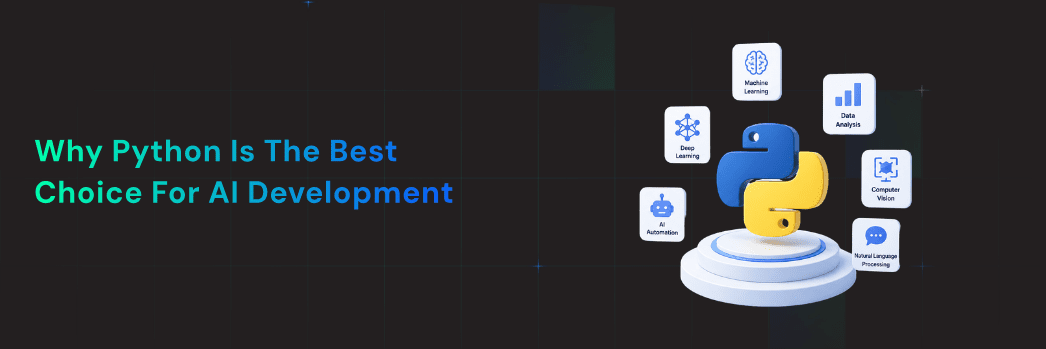
The most popular Python libraries make it possible to perform data processing, predictive models, neural networks, and deep learning. Python-based AI development structures handle sophisticated functions such as image recognition, speech processing, recommendation systems, and autonomous decision-making systems. The flexibility enables the AI software development services to provide high-end, enterprise-level solutions to industries.
To companies, this implies that development cycles run quicker, cost less, and become state-of-the-art technology. Developing AI software firms with the help of Python are able to scale solutions to evolving business demands rather rapidly and with minimal performance and error rates.
Strong Community Support
The Python community is among the most active developers in the world. This is very strong community support, which is crucial in the fast evolution of Python development. The developers also constantly add open-source tools, libraries, updates, and best practices, which enhance the overall AI ecosystem.
In the case of AI development companies, such a community-based environment allows them to constantly learn, solve their issues more quickly, and have the opportunity to use the latest innovations. Bugs are soon discovered and patched, security patches are published on a regular basis, and new AI methods are soon ported into Python frameworks.
In terms of business, well-developed community support will make AI projects sustainable in the long term. Python offers companies investing in artificial intelligence a language that keeps pace with the changes taking place in the technological industry, making their AI systems stay relevant and competitive.
Advantages of Using Python in AI Projects
In addition to the features, Python has practical benefits that warrant it as the language of choice in developing solutions in AI software development. These benefits have a direct effect on the efficiency, scale, and business performance of the project.
Rapid Prototyping
Speed is an essential aspect of AI innovation. Python also supports rapid prototyping, where ideas or algorithms can be tested in a short time, and models can also be validated before being scaled. This is fundamental in artificial intelligence program development, where more experiments are done to achieve improved accuracy and performance.
Python also allows AI development companies to develop working prototypes in a shorter time, allowing businesses to evaluate the viability and ROI sooner in the development cycle. Rapid prototyping minimizes risk, time, and time-to-market, providing the companies with the competitive edge in the fast-changing markets.
In organizations that invest in AI to support learning and development or customer-facing applications, this agility also means that the solutions can be fine-tuned according to the feedback given in the real world before deployment.
Cross-Platform Compatibility
Python is also a cross-platform language, which is why AI programs written in Python can operate without any issues on various platforms, such as Windows, macOS, and Linux, among others. This compatibility makes the deployment easier and provides a similar performance across environments.
Cross-platform support in Python AI development enables businesses to implement AI solutions on cloud systems, on-premise systems, or hybrid infrastructures with relatively minor changes. This is especially useful to enterprises working in various regions or with different technology stacks.
In the case of AI software development firms, cross-platform compatibility makes the development process less complex and offers scalable solutions that expand in tandem with the business requirement. It also facilitates cost optimization since it provides businesses with an opportunity to select infrastructure that best suits their operation needs.
Integration Capabilities
There is an exception that modern AI systems do not work in isolation. They should be fully compatible with existing software and databases, APIs, and enterprise systems. Python can be said to be the best in terms of its integration features, and thus, it is the best programming language to use when designing software applications that are complex with artificial intelligence.
Python can be used to develop AI because it can be easily integrated with web applications, data pipelines, cloud services, IoT devices, and third-party tools. This makes AI solutions an extension of business operations and not detached systems.
In the case of businesses, it implies AI-based automation, more intelligent analytics, and better decision-making within the departments. Python-based AI software development services have the ability to create solutions that can integrate seamlessly with CRM systems, ERP platforms, learning management systems, and customer-facing applications.
Real-World Applications of Python in AI
Python is an important programming language in enabling AI applications in the real world. Its adaptability has allowed AI development businesses to respond with smart solutions to sophisticated business challenges that are capable of giving rise to quantifiable value.
Python finds application in the medical field to cover medical imaging, disease forecasting, patient analysis, and customized treatment planning AI systems. These applications can increase the accuracy of the diagnosis and improve patient outcomes based on data-driven insights. AI Python facilitates the ability of healthcare providers to work with large quantities of medical data in an efficient and safe manner.
Artificial intelligence in finance, which is implemented in Python, is used to detect fraud, risk, algorithmic trading, and credit score. Python-based AI models are used to analyze transactional patterns, identify anomalies, and make real-time decisions that protect customers and extend profitability in financial institutions.
The Python AI development is used in retail and e-commerce to drive recommendation engines, demand forecasting, dynamic pricing, and customer behavior analysis. These AI applications assist companies with personalizing user experiences, optimizing inventory, and increasing conversion. Python is employed to create scalable systems in AI software development companies to support the dynamism in consumer preferences.
AI in learning and development is becoming important in education and corporate training. Python AI applications make learning strategies personal, evaluate skills gaps, and provide smart recommendations of learning materials. Such systems also promote the performance of employees and ongoing learning programs.
Python has applications in manufacturing and logistics in predictive maintenance, quality control, supply chain optimization, and robotics automation. Python is a fundamental technology in the creation of AI technology in industrial applications because AI-driven insights decrease downtime, enhance performance, and reduce operation expenses.
In all these industries, companies have the best AI development companies to provide customized Python-based AI software development solutions that are in line with their strategic objectives.

Conclusion – Python as the Future of AI Development
Python has established itself as the best language to use when creating artificial intelligence software. Its easy language, large ecosystem, well-supported community, and unparalleled flexibility make it the most appropriate in creating intelligent systems that are scalable, efficient, and future-ready. Python allows businesses to innovate quicker and smarter, whether it is rapid prototyping, smooth integration, cross-platform deployment, or more.
With the current increase in the demand of AI, companies need to engage the services of established AI development firms specializing in Python AI development. With the help of the services of AI software development, developed on the Python platform, businesses have access to powerful insights, process automation, customer experiences, and sustainable growth.
Python continues to be at the center of AI technology development, whether it is artificial intelligence in the area of learning and development or automation of enterprises or other advanced analytics. Its flexibility and constant change can guarantee that it will continue to be the backbone of the innovation in artificial intelligence in the coming years. As far as businesses to which scalable, reliable, and smart solutions matter the most, Python is not only the best option but also the future of AI development.
Frequently Asked Questions
Q1. Why is Python the preferred choice in the development of AI?
Python has been adopted in AI development because of the simplicity in its syntax, numerous AI libraries, faster development of prototypes, and good community support towards innovations.
Q2. Why does all AI use Python?
Python is the language most frequently used in AI due to its support of powerful frameworks, simple data management, fast testing, and flawless connection with machine learning tools.
Q3. Python or artificial intelligence Which is the better one?
Python is a programming language, and artificial intelligence is a technology. Python assists in the creation of AI solutions, their training, and their deployment.
Q4. What are the merits of Python?
Python is readable, more rapid, richly equipped, cross-platform, and high-performing in web, AI, and automation applications.
Q5. Why is Python the best?
Python is superior because it is simple, versatile, has a vast ecosystem, is scalable, and can be used to support AI, data science, and current applications.
Search
Recent Post
- How AI in Mobile App Development Is Transforming Apps in Real Use
- Generative AI vs Agentic AI: A Complete Guide to Their Key Differences
- Accelerate UI/UX Prototyping with Design Systems in the USA
- Top 10 Mobile App Development Challenges Faced in the USA Market
- How to Choose the Best Mobile App Development Company in the UK
- Why PHP Web App Development Remains Ideal for Scalable Business Growth
Categories
- Digital marketing (14)
- E-Commerce Development (13)
- Mobile App Development (46)
- software development (4)
- UI/UX Design (6)
- Website Development (21)
You may also like
How AI in Mobile App Development Is Transforming Apps in Real Use Working with the Right Team Introduction Artificial Intelligence...

Generative AI vs Agentic AI: A Complete Guide to Their Key Differences Working with the Right Team Introduction The world...
Accelerate UI/UX Prototyping with Design Systems in the USA Working with the Right Team Introduction In the intensely competitive digital...